This blog is dedicated to electric powered remote control airplane and park flyer enthusiasts. It serves as a resource for newbies, novices, and intermediate pilots.
What fun! Today is the first big snow fall we have had all season (powder, then frozen rain, and then more powder. Snow was mildly frozen on the surface. Perfect for RC snow skis). So I installed my Dubro Parkflyer Snow Skis I purchased for $10 from my local hobby store. I taxi'd around my backyard and had a couple super short and low altitude flights. I loved it. The plane is fast on snow.
The directions supplied from Dubro were helpful, but not perfectly clear. I drilled a few extra holes in my skis that I didn't need, because the directions were confusing. So I cheated and went online and Googled the installation and found a guy who posted pictures of his slow flyer with a pair on. I, too, am posting pictures for you to see so you can avoid the hassle all together.
Enjoy taking-off from snow and landing on it. I found the snow and skis to be VERY forgiving.
If you have a 3-channel airplane the first stunt you will learn to do is loops. Before you attempt your first loop make sure that you are 3-mistakes high (75 feet) in case your plane stalls and looses altitude.
Inverted loops will be more difficult to achieve if your wings are dihedral, since your plane will not trim easily while upside down. My Graupner Mini Piper hated to fly upside down. The best I could do was very shallow dives.
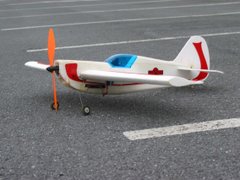
Selecting your second plane will be a less daunting task than your first. Now that you know how to fly and how you want your next plane to perform you can begin researching. For my third plane, I bought a "Extra Stiffy" by Copperhead Aviation fully loaded with Hitec 56-B servos and the recommended Hacker motor and Phoenix ESC. The reviews for this plane were great. I knew I would reuse my transmitter and a receiver.
As you can see the build for this plane is not too demanding. I bought my plane a friend are pre-built and flown. I don't recommend doing this unless you truly trust the person.
If you plan to buy a new radio and high performance plane, I highly recommend you purchase a 2.4 ghz 6-channel Spectrum radio. Read the reviews! For my fifth plane I will buy the Spectrum and go nitro powered.
If I was purchase my second plane all over again I would buy a Parkzone Typhoon RTF for $215 (watch for Black Friday sales . . . I have seen for $169 at www.nesail.com). Unfortunately, I can't find a photo of it that I can save and post on this site. The plane requires very little assembly and performs very well. Parts are readily available at your LHS (local hobby store). If you purchased a 2 or 3-channel beginner's plane without a reusable servos and receiver, the Parkzone Typhoon is probably the best bet. Spurge for the lipo battery too.
Visit www.youtube.com for videos of the Parkzone Typhoon.
Though I am impressed with technology and the ability to produce such a tiny 2-channel EPP-durable helicopter for $29, I easily bore of anything that is 2-channel, whether car, plane, or helicopter.
A 2-channel helicopter can go up/down and spin counter/clockwise, but not fly forward. The Air Hogs Havoc has plenty of power and climbs nicely indoors or outdoors.
My recommendation, if you want an inexpensive indoor/micro helipoter is the Air Hogs Helix 6-channel helicopter for $79 at Target or Toys-R-Us. If you want an electric outdoor helicopter, visit www.hobby-lobby.com.
My second plane is a EPP foamie: "The Potensky Eagle". I have replaced the ESC (electric speed control) with a Great Plance C-12 and put a EPS350 motor/gearbox (5.33x1) and a slowflyer large prop on it after a nose dive broke the gear drive. It does not have the power that I want, but does fly slowly and gives me the opportunity to practice my aerobatics. Below is a Youtube.com video of the Eagle. Other videos are also posted, just search for "Quiet Flyer".
My third plane is another foamie -- the Copperhead Extra Stiffy with a brushless motor. This plane will be put me in a whole new league of performance. But first I want to master my Eagle.
Dave has gotten used to his Hobbyzone Scout, which out-performs his Hobbyzone Outlaw he replaced. The Scout is much more sensitive to turns because the V-tail control direction as opposed to two motors (like the Yellow Bee in the earlier post). The Scout is a bit quick, but flies stable and confidently allowing Dave to fly at very low altitudes confidently. The plane has good power and can climb at a decent angle to gain altitude.
There are two key points to remember when flying regarding avoiding crashes:
The first is to fly at three mistakes high -- each mistake is 25 feet high. The idea being that if you loose control doing a stunt you will loose altitude to 50 feet in the air and then take an additional 25 feet to recover control; therefore you gain control 25 feet of the ground, which is a safe altitude. If you are closer to the ground it is likely you will crash.
Dave flew three mistakes high and cut motor while giving full left turn to cause the plane to spiral. His mistake was when it lost control he did NOT let off the controls (which would self correct itself); rather he gave full power to pull out. It did not work
Thesecond is to know that the plane always wants to self-correct itself. This means that the plane WANTS to fly level and straight. Beginner RC airplanes and most full scale personal planes are great at this. What you must do is zero out all your controls -- absolutely no throttle or turning or elevator. The plane correct irself given you have adequate height.
If you are too close to the ground, you will need to decide what's the best approach, i.e. full power and full up elevator (what ever you do give the radio the is opposite of what the plane is doing. So if the plane is headed downward in a left spiral give up/right to counter correct.
Dave's first test flight was a success, but he flew on too windy of a day and ended up down-wind and could not bring it back; therefore he lost it over a residential neighborhood. He recovered it after it had crashed into a tree and smack against the concrete. His wing was snapped in half. He bought a replacement, not stock, which is slightly larger.
He complained that the plane seemed to lack power. He informed me that he charged his NiMH batteries two weeks ago. Note: NiMH batteries loose power over time and it is best to charge the night before or day of so you have the batteries at full capacity.
Dave hand launched since he could not find his wheels. His plane took off nicely. I suspect with a battery charged at full capacity it would climb a little more quickly.
As suspected the Hobbyzone Scout is a stable flyer. It's best to have a large field and windless day to get use to its behaviors.
It makes a great first airplane if you are unsure if the hobby is one you will be in for the long haul, because at $50 it is something you could walk away from.
After we've been flying successfully for a while, we all get the itch to fly more often! Without dispute, in the rc community (at least online) the most inexpensive "scratch" is the AirHogs Aero Ace, which can be purchased for between $25-$29 at Target, Toys-R-Us, and K-Mart (watch for coupons for 10%). What makes these little planes better than the rest is it has differianted speed control; others only have speed #1, speed #2, and speed #3 buttons. Don't buy any other version -- trust me, I did and I was disappointed. The Aero Ace comes as a bi-plane and a jet.
Available at aeroacemods.com are all sorts of upgrades, including wheels (it will ROG -- roll off ground) and night lights. I often use the night lights to fly in my backyard:I usually can climb about 40-50 feet high on a no-wind evening and have a seven minute flight with "throttle maintenance."
In the picture above I added floats to my Aero Ace. You need styrafoam, hobby knife, fine grit sandpaper, balsa, and waterproof glue -- and a hot glue gun to mount the floats. The secret is to make the floats as small as possible in every way, but length. Floats should be 70-75% the length of the plane. CG (Center of Gravity) is tricky, but a visit to the forums at rcuniverse.com or rcgroups.com will be very helpful. Keep playing with it until it flies stable. My plane is a bit rocky and nose heavy, but some adjustments should result in better flight.
I am not a big fan of 2-channel RC airplanes, because of the lack of control with altitude. If you are in a bad situation, climbing or diving quickly is not possible and furthermore, forget about trying to do basic aerobatics. But nonetheless, they are fun inexpensive planes. I own a SDM Yellow Bee and I use it for testing new things out, like home-made floats. It's my guinea pig.
Dave recently replaced his Hobbyzone Firebird Outlaw with a Firebird Scout. His maiden flight was in 7 MPH winds. As nearly an intermediate pilot, he has the skill to fly in these conditions. But sadly, he got behind the wind and was not able to bring the plane to the landing strip (baseball diamond). He was swept over a neighborhood house and crashed into a tree and the plane fell upside down and snapped its wings. In less wind, this plane would perform very nicely. It is a SMALL plane.
I did not fair so well with my SDM Yellow Bee (can be bought for $25-29 at your local Harbor Freight Tools) either. The wind was throwing me all over the place. I was trying to keep my flight very close to the baseball diamond so Dave could video tape it. Low level flight in high winds is not easy. And I eventually got caught with the wind behind me and almost crashed into the dug-out box behind me in the photo. I just missed hitting it head on by about 2 feet.
As you can see from the photo to the right I sustained very little damage. A broken V-tail and prop. With 5-minute epoxy and packaging tape this plane will be as good as new in less than 7 minutes and will fly as if this crash never happened. If I had my 4-channel plane I don't believe I would have ever been in this situation with a near death experience for the plane. I am replacing the gearbox on my 4-channel foamie and hope to have some posts up for you to view.
Moral of this story: know the limits of your 2-channel airplane and only fly in conditions that you know with absolute certainty you can handle. Wait a few days if that's what it takes for the weather to let up. Contrary to what I believed when I first started flying, flying in all weather conditions does not make you a better and more succesful pilot, but rather proves you level of impatience and the only thing you will master is repairing your airplane and questioning why you went up in the first place. I destroyed three airplanes now, but have finally learned to be patient.
 What fun! Today is the first big snow fall we have had all season (powder, then frozen rain, and then more powder. Snow was mildly frozen on the surface. Perfect for RC snow skis). So I installed my Dubro Parkflyer Snow Skis I purchased for $10 from my local hobby store. I taxi'd around my backyard and had a couple super short and low altitude flights. I loved it. The plane is fast on snow.
 The directions supplied from Dubro were helpful, but not perfectly clear. I drilled a few extra holes in my skis that I didn't need, because the directions were confusing. So I cheated and went online and Googled the installation and found a guy who posted pictures of his slow flyer with a pair on. I, too, am posting pictures for you to see so you can avoid the hassle all together.