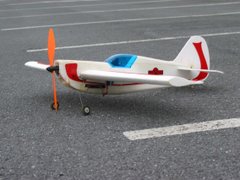
Here's an old challenge of building free flight planes that my friend, Pilot Dave, and I use to do. You can find photos and descriptions of our competitions at:
www.rcplanepilot.blogspot.com
I challenge all readers and lurkers of this blog to build a set of functional floats for one of these free flight electric planes and video tape it landing in a pool of water. Or build a plane that will fly for 2 minutes or more and video tape.
Please send me photos and link of the video and I will gladly post it.
Next time the wind is a 0 MPH I will record a video of these birds (in the video) flying and post them.
Saturday, November 03, 2007


Friday, November 02, 2007
Repairs after a nose dive
It's been two years since I have had a wreck (not counting screwing around with the Yellow Bee) and sadly . . . as all experienced pilots say:
"Everyone crashes. If you don't then you're not flying."
I have gotten too comfortable . . . I was in the process of landing after a ten minute flight using throttle maintenance, so I should have had plenty of power for landing. I was flying to an adjacent baseball diamond, a last minute decision, because of the wind direction and I had to cross the sun. I juiced the throttle to fly above the sun from my point-of-view to avoid being blinded . . . suddenly my plane dove -- I was 12 to 18 feet from the ground. I panicked. I over sticked and my plane spiraled. I could not tell if I was upside up or upside down.
To this day I wonder if my batt was to low and ESC cut power momentarily. That's the only way I can explain the dive.
The obvious solution would have been to land in the grass next to me so I could see my plane and guide it to the ground safely.
 Above is what my plane looked like after the hard nose dive and somersaulted across the grass field at a local park. As you can see this is a critical spot that endures a lot of stress, because it houses my motor mount. The prop didn't fair to well either.
 Typically the longer it takes for an epoxy to cure the heavier the epoxy weighs. It is best to use as little epoxy as possible, but in case like this I was generous. You should wipe off all excess glue immediately. Ninety-five percent of the time CA glue or 5-minute Epoxy is the best choice for park flyers, but this time I used 24-hour epoxy because I need this bond to be very strong. This slower epoxy also allows me to set everything perfectly and check and then recheck.
 The best way to tighten up the sides in a glue job like this is criss-cross your needles at opposing angles. This will not only pull the sides closer together, but also hold them better. I should have done that more on this job, but if you look at the top end you will see that I did.
I aim to fly again as soon as the weather permits.
"Everyone crashes. If you don't then you're not flying."
I have gotten too comfortable . . . I was in the process of landing after a ten minute flight using throttle maintenance, so I should have had plenty of power for landing. I was flying to an adjacent baseball diamond, a last minute decision, because of the wind direction and I had to cross the sun. I juiced the throttle to fly above the sun from my point-of-view to avoid being blinded . . . suddenly my plane dove -- I was 12 to 18 feet from the ground. I panicked. I over sticked and my plane spiraled. I could not tell if I was upside up or upside down.
To this day I wonder if my batt was to low and ESC cut power momentarily. That's the only way I can explain the dive.
The obvious solution would have been to land in the grass next to me so I could see my plane and guide it to the ground safely.
 Above is what my plane looked like after the hard nose dive and somersaulted across the grass field at a local park. As you can see this is a critical spot that endures a lot of stress, because it houses my motor mount. The prop didn't fair to well either.
 Typically the longer it takes for an epoxy to cure the heavier the epoxy weighs. It is best to use as little epoxy as possible, but in case like this I was generous. You should wipe off all excess glue immediately. Ninety-five percent of the time CA glue or 5-minute Epoxy is the best choice for park flyers, but this time I used 24-hour epoxy because I need this bond to be very strong. This slower epoxy also allows me to set everything perfectly and check and then recheck.
 The best way to tighten up the sides in a glue job like this is criss-cross your needles at opposing angles. This will not only pull the sides closer together, but also hold them better. I should have done that more on this job, but if you look at the top end you will see that I did.
I aim to fly again as soon as the weather permits.
Sunday, October 28, 2007
Graupner Mini Piper Make-Over

I made over my Hobby-Lobby Graupner Mini Piper to look like the Grasshopper L-7 Army plane. My Piper is not 100% fully authentic in appearance, but I am happy with the outcome nonetheless.
 I am not happy with how these pictures came out beneath the flourescent lights in my kitchen. I will take more photos outside on a sunny day, which will show you how nice the plane really looks.
 The flourescent lights called attention to all the blemishes of the plane, whereas when you look at it with the naked eye you don't see them.
The video camera did not do any justice to how nice the plane came out either.
Bummed with the photos and videos!
Video cameraing a plane is not easy
With our new video camera Pilot Tom shot the film. It is really challenging to record a plane. I did not do any stunts in this video and tried to keep a slow speed for Tom.
I really recommend that the pilot and camera person discuss a flight pattern before take-off and the pilot will need to cue the camera person in on when he/she will speed up so the camera can zoom out first. The pilot needs to fly lower to the ground and closer to the camera than I did.
If the camera can be manually focused I recommend that. If not, for the sake of the auto focus the pilot should maintain the same amount of distance from the camera and the same speed in order to produce a crisp video.
I really recommend that the pilot and camera person discuss a flight pattern before take-off and the pilot will need to cue the camera person in on when he/she will speed up so the camera can zoom out first. The pilot needs to fly lower to the ground and closer to the camera than I did.
If the camera can be manually focused I recommend that. If not, for the sake of the auto focus the pilot should maintain the same amount of distance from the camera and the same speed in order to produce a crisp video.
The most amazing wreck ever
 Since I began flying again four years I have destroyed at least two to three planes. I have had some seriously spectacular wrecks, where upon impact into the ground my planes have shattered into pieces leaving nothing but a stryafoam snow storm to fall down and bury my wreckage.
 Pilot Tom is still learning the nuances of flying. His plane had previously suffered a broken wing and required a new servo. His repairs were perfect and he was airborne once again.
 During Tom's past flight he attempted a loop from level flight, but lacked power. I told him to pick up speed and dive about 10-15 feet and then pull into a loop. He streamed across the sky and dove. The moment he pulled up elevator the entire park heard a BOOM! as the G-Force of the plane split his wing halves and the left side of the wing fluttered down slowly and safely . . . as pictured below.
Wile this was happening Tom killed all throttle and tried to straighten out his plane with mild input to keep it from the death spiral it was in. He was able to gain some control as it fell 40 to 5o feet to the ground. We were 30 to 40 yards from the plane and there was nothing anyone could do. It was a spectacular sight watching this plane spin out of control towards the earth -- like a WWII dog fight that ended bad.
 I was skeptical that the fuselage would be able to be repaired. Tom surveyed the damage and over the next week was able to massage the plastic fuse back into shape, build a wood servo bay to replace the broken plastic one, repair the ripped plastic where the tail slips into, and replace the other servo. Finally, he used 5-minute epoxy to glue the seam where the wing halves meet to avoid the wings pulling apart under pressure again. His plane flew again as seen below . . .
Beautiful take-off Tom!
Wednesday, July 11, 2007
Saturday, June 30, 2007
Homemade Micro RC Airplane
Using a $1.99 rubber-band powered P-51 Mustang I bought from Harbor Freight Tools along with the guts from an Air Hogs Aero Ace I created a 2-channel micro flyer.
 Above you can see the charging mechanism cut and installed into the fuselage. Below you will see the same with the li-po battery. I used hot glue to secure them.
 Using a Xacto blade I cut slits in the styrafoam to lock/protect the wires and to avoid them dangling, which could catch something on landing.
 I started this project with a Combo package (see below) I bought on clearance from Target for $17.00. I intended to create a flying wing micro flyer, which I expect would be a rather quick plane.
 I scrapped this idea because I do not know enough about CG (center of gravity) for flying wings; therefore I will research this further and use another Aero Ace to build this plane.
 First, remove the top wing on the Aero Ace and then using your thumb and index finger slowly thumb it apart from the nose back. It is glued together with rubber cement. That goo will be left on the parts and engines -- just re-stick it. It will stay. Or you can use a small amount of hot glue.
 Be very careful when removing the guts, especially the antennae (which goes through the rudder)! Take your time and pull gently!!
 The video at the top of this posts explains "how to" as well.
Wednesday, June 20, 2007
Can crap fly?
 This post is dedicated to amateur competitive eating man Megamunch (Dave), who is also a pilot. His philosophy in flying is "crashing is as fun as flying." With that approach to the hobby one can not justify spending several hundred on a plane, BUT that does present the pilot with a challenge: can you make crap fly?
Dave bought a lemon of a plane for $80 from Harbor Freight Tools -- an SDM Piper. Since then he has invested at least another $80 and built up his plane with a geared 370 motor and larger prop. He upgraded the battery to 9.6v and added some large bush plane style wheels.
Keep posted for a windless morning when Dave and I are both free and I will video tape this bird's maiden voyage. I suspect she'll fly.
Hobby-Lobby's Wing Dragon

Tom bought his 3-channel Wing Dragon on sale from Hobby-Lobby for $79 total. The plane comes as an RTF with flight sim software and USB connector for your transmitter to your PC. It is by far the best 3-channel plane that I have seen for under $100 and will compete with the $150 RTFs out there. This plane has good power and an awesome glide range. From 75 feet high I glided over 60 yards after the battery died and landed on my mark in the baseball diamond. It is a great plane for a beginner pilot and offers the most bang for the buck. It will perform loops and other basic aerobatics.
Here Tom taxis around the landing strip at our local ball field. I did not charge the battery the night before so he lacked a full charge and did not have enough power to fly.
The secret to a good flight
Tom has his best flight ever flying his Hobbyzone plane. He is learning that the LEAST amount of input (moving the sticks on the transmitter) results in the BEST flights without as many errors or crashes. The best advice I was given when learning to fly was "let the plane fly itself. Only change direction when you really need to." Thanks Yhunuan, you were absolutely correct.
Your goal as a pilot is to keep the plane flying level and straight. If the plane is going down/left give the opposite of up/right until the plane is level and straight again.
Remember, giving input into the transmitter is like cutting hair. It's better to cut only a little and if you need your hair shorter to cut just a little more. If you cut a lot you can never correct it, just wait for the hair to grow back. The same with an airplane, if you give too much stick it is highly possible that you will not be able to correct and you will crash.
Your goal as a pilot is to keep the plane flying level and straight. If the plane is going down/left give the opposite of up/right until the plane is level and straight again.
Remember, giving input into the transmitter is like cutting hair. It's better to cut only a little and if you need your hair shorter to cut just a little more. If you cut a lot you can never correct it, just wait for the hair to grow back. The same with an airplane, if you give too much stick it is highly possible that you will not be able to correct and you will crash.
Subscribe to:
Posts (Atom)